Asymmetrical Horn Antennas
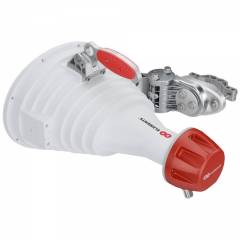
RF elements Asymmetrical Horn CC antennas are directional horn antennas designed for wireless networks operating in the 5180–6000 MHz frequency range. Their asymmetrical radiation pattern provides different beam widths in the horizontal and vertical planes, allowing coverage to be directed according to the requirements of a particular deployment. Unlike antennas with similar beam widths in both planes, this configuration allows the horizontal coverage angle and vertical signal distribution to be considered separately when planning a wireless network. The series combines high beam efficiency with a stable radiation pattern throughout the operating frequency range, making these antennas suitable for high-density access point clusters and sites where multiple antennas are installed close together.
The horn design provides precise radiation patterns and excellent noise rejection, helping control the direction of transmitted and received signals. Compared with traditional patch array sector antennas, the Asymmetrical Horn CC series offers greater radiation pattern stability across its operating bandwidth. This characteristic is especially relevant in installations where the intended coverage area must remain consistent across the frequencies used by the connected radio equipment. Each antenna features dual linear horizontal and vertical polarization and two N Female connectors for connection to compatible radio equipment. The different beam configurations available within the series allow installers to select an antenna according to the required coverage area, antenna placement and arrangement of neighbouring wireless sectors.
Directional Signal Coverage
The Asymmetrical Horn CC series is designed to provide controlled directional coverage while limiting unwanted radiation outside the intended area. Its radiation characteristics make it particularly relevant for installations with densely located access points, where precise coverage planning and noise rejection are important considerations. The antennas maintain stable gain and radiation characteristics across their operating bandwidth, supporting consistent directional coverage throughout the specified frequency range. Their asymmetrical beam geometry allows network designers to distinguish between the required horizontal coverage and the vertical extent of the radiation pattern, rather than treating both directions as a single coverage angle.
Each antenna uses a dual-polarized configuration with separate N Female connections for horizontal and vertical polarization. The 50-ohm impedance and standard RF connectors allow integration with compatible wireless radio equipment. Different models in the series provide different antenna gains and horizontal and vertical beam widths, enabling the appropriate configuration to be selected according to the network layout. A narrower horizontal beam can be selected when coverage needs to be concentrated within a more limited angular area, while a wider configuration can serve installations requiring a broader sector. These characteristics are particularly useful when planning wireless coverage across multiple sectors or positioning several antennas at the same installation site, where the relationship between adjacent radiation patterns is an important part of network planning.
Mounting and Alignment
RF elements Asymmetrical Horn CC antennas are designed for outdoor installation and feature an IP55-rated enclosure. Their construction combines UV-resistant ABS plastic, polycarbonate, HDPE, aluminium and stainless steel. The antennas are specified to withstand wind speeds of up to 160 km/h, making them suitable for exposed mounting locations within their stated environmental limits. The combination of weather-resistant construction and directional antenna geometry allows the series to be used in outdoor wireless installations where both the physical mounting arrangement and antenna orientation must be considered. The enclosure and mounting components form an integrated assembly intended for installation on a suitable support structure.
The mounting system allows installation on poles and provides mechanical adjustment in both the azimuth and elevation planes. This enables the antenna direction and vertical angle to be adjusted during installation, helping align the radiation pattern with the intended coverage area. Horizontal adjustment changes the direction in which the antenna faces, while elevation adjustment allows the main beam to be oriented higher or lower relative to the mounting position. The adjustable mounting arrangement is particularly relevant for directional antennas, where orientation determines the direction of the main beam. Different models have their own mounting dimensions, supported pole diameters and adjustment ranges, allowing the installation to be planned according to the selected antenna and available mounting structure. These mechanical adjustments also allow the antenna orientation to be refined during installation without changing the selected beam configuration.
Technical Specs / Datasheet




Reviews and ratings
Product rating