%20-%20https://sketch.com%20--%3e%3ctitle%3esearch_ico%3c/title%3e%3cdesc%3eCreated%20with%20Sketch.%3c/desc%3e%3cg%20id='elements'%20stroke='none'%20stroke-width='1'%20fill='none'%20fill-rule='evenodd'%3e%3cg%20id='svg_elements'%20transform='translate(-372.000000,%20-152.000000)'%20fill='%23131515'%3e%3cpath%20d='M387.655562,160.498039%20C387.655562,162.294118%20386.925169,163.922549%20385.746738,165.102941%20C385.745758,165.104902%20385.743797,165.104902%20385.742816,165.105882%20C385.740856,165.107843%20385.740856,165.108824%20385.739875,165.110784%20C384.558503,166.289216%20382.930071,167.019608%20381.133993,167.019608%20C377.537914,167.019608%20374.612424,164.094118%20374.612424,160.498039%20C374.612424,156.901961%20377.537914,153.976471%20381.133993,153.976471%20C384.730071,153.976471%20387.655562,156.901961%20387.655562,160.498039%20M381.133993,152%20C378.864385,152%20376.730071,152.884314%20375.125169,154.489216%20C373.520267,156.094118%20372.635954,158.228431%20372.635954,160.498039%20C372.635954,162.767647%20373.520267,164.901961%20375.125169,166.506863%20C376.730071,168.112745%20378.863405,168.996078%20381.133993,168.996078%20C383.070267,168.996078%20384.905562,168.348039%20386.399679,167.161765%20L390.948699,171.710784%20C391.134973,171.897059%20391.383993,172%20391.647718,172%20C391.911444,172%20392.159483,171.897059%20392.345758,171.710784%20C392.533012,171.52451%20392.635954,171.276471%20392.635954,171.011765%20C392.635954,170.748039%20392.533012,170.5%20392.346738,170.312745%20L387.797718,165.763725%20C388.983012,164.269608%20389.632032,162.434314%20389.632032,160.498039%20C389.632032,158.228431%20388.747718,156.094118%20387.142816,154.489216%20C385.537914,152.884314%20383.403601,152%20381.133993,152'%20id='search_ico'%3e%3c/path%3e%3c/g%3e%3c/g%3e%3c/svg%3e)
%20-%20https://sketch.com%20--%3e%3ctitle%3ebasket_ico%3c/title%3e%3cdesc%3eCreated%20with%20Sketch.%3c/desc%3e%3cg%20id='elements'%20stroke='none'%20stroke-width='1'%20fill='none'%20fill-rule='evenodd'%3e%3cg%20id='svg_elements'%20transform='translate(-604.000000,%20-152.000000)'%20fill='%23FFFFFF'%20fill-rule='nonzero'%3e%3cpath%20d='M617.885886,152.156132%20C618.251208,151.893333%20618.764816,151.969846%20619.033242,152.328759%20L619.033242,152.328759%20L623.508326,158.308798%20L625.787011,158.308798%20C626.028367,158.308798%20626.257391,158.412965%20626.413369,158.593644%20C626.569346,158.774324%20626.636377,159.013262%20626.596631,159.246552%20L626.596631,159.246552%20L624.544393,171.326984%20C624.478478,171.715449%20624.136145,172%20623.734729,172%20L623.734729,172%20L607.48092,172%20C607.079805,172%20606.737214,171.715154%20606.671257,171.326984%20L606.671257,171.326984%20L604.619019,159.246552%20C604.579358,159.013009%20604.64639,158.774366%20604.802367,158.593686%20C604.958344,158.413007%20605.187368,158.30884%20605.428725,158.30884%20L605.428725,158.30884%20L607.488225,158.30884%20L611.963352,152.328759%20C612.231779,151.970352%20612.745644,151.893038%20613.110966,152.156132%20C613.476287,152.419478%20613.55535,152.923365%20613.286923,153.282026%20L613.286923,153.282026%20L609.525167,158.30884%20L621.471685,158.30884%20L617.709929,153.282026%20C617.44176,152.923661%20617.520307,152.419478%20617.885886,152.156132%20Z%20M624.818105,159.919568%20L606.397674,159.919568%20L608.176286,170.389273%20L623.039492,170.389273%20L624.818105,159.919568%20Z%20M615.607889,161.798742%20C616.061297,161.798742%20616.428767,162.159258%20616.428767,162.604085%20L616.428767,162.604085%20L616.428767,167.892644%20C616.428767,168.337766%20616.061297,168.698028%20615.607889,168.698028%20C615.154481,168.698028%20614.787011,168.337513%20614.787011,167.892686%20L614.787011,167.892686%20L614.787011,162.604085%20C614.787011,162.159258%20615.154481,161.798742%20615.607889,161.798742%20Z%20M619.849179,161.798742%20C620.302587,161.798742%20620.670057,162.159258%20620.670057,162.604085%20L620.670057,162.604085%20L620.670057,167.892644%20C620.6701,168.337766%20620.30263,168.698028%20619.849179,168.698028%20C619.395771,168.698028%20619.028301,168.337513%20619.028301,167.892686%20L619.028301,167.892686%20L619.028301,162.604085%20C619.028301,162.159258%20619.395771,161.798742%20619.849179,161.798742%20Z%20M611.366599,161.798742%20C611.820007,161.798742%20612.187478,162.159258%20612.187478,162.604085%20L612.187478,162.604085%20L612.187478,167.892644%20C612.187478,168.337766%20611.820007,168.698028%20611.366599,168.698028%20C610.913191,168.698028%20610.545721,168.337513%20610.545721,167.892686%20L610.545721,167.892686%20L610.545721,162.604085%20C610.545721,162.159258%20610.913191,161.798742%20611.366599,161.798742%20Z'%20id='basket_ico'%3e%3c/path%3e%3c/g%3e%3c/g%3e%3c/svg%3e)
A large yard, campsite or industrial site rarely needs Wi-Fi in every direction. It needs a strong, controlled signal aimed at the area where people and devices actually are.
The MikroTik mANTBox ax 15s combines a Wi-Fi 6 access point, directional sector antennas, RouterOS, passive PoE and an SFP uplink in one outdoor unit. Its main advantage is not a headline range figure. It is the ability to cover one defined sector or serve several remote wireless clients without building a system from separate radios and antennas.
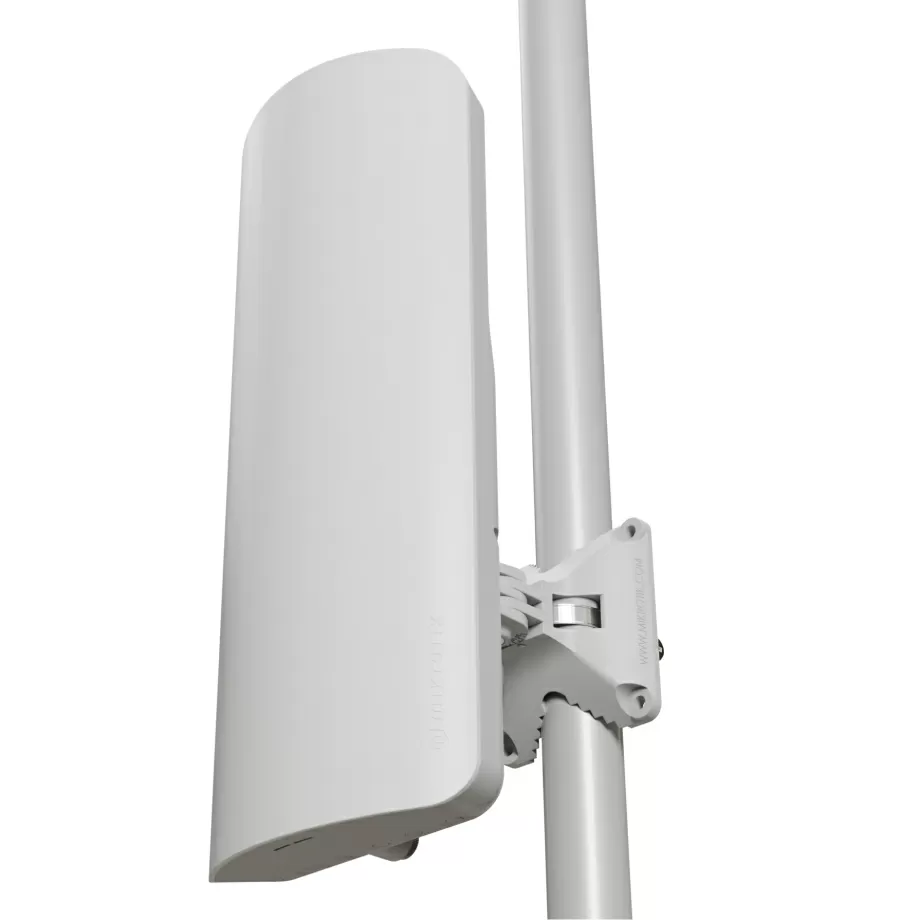
MikroTik mANTBox ax 15s sector access point.
Key takeaways
- mANTBox ax 15s is a sector access point, not a 360-degree outdoor hotspot.
- The advertised long-distance capability applies to planned links with directional CPEs, not ordinary phones.
- 5 GHz is the main capacity band; 2.4 GHz is useful for compatibility and longer local reach.
- Alignment, mounting height and line of sight usually matter more than the maximum data rate.
- The 2.5G-capable SFP uplink is useful for fiber and aggregate traffic, but it does not make every client faster.
Contents
What is mANTBox ax 15s designed to do?
A normal outdoor access point spreads signal around the installation point. That is useful beside a small building, but inefficient when all users are located in front of one wall, along one row of cabins or across one yard.
mANTBox ax 15s uses built-in sector antennas to concentrate coverage in a defined direction. It can work as an outdoor access point for phones, tablets and laptops, or as a point-to-multipoint base station for dedicated remote CPEs.
Product details: MikroTik mANTBox ax 15s at Getic.
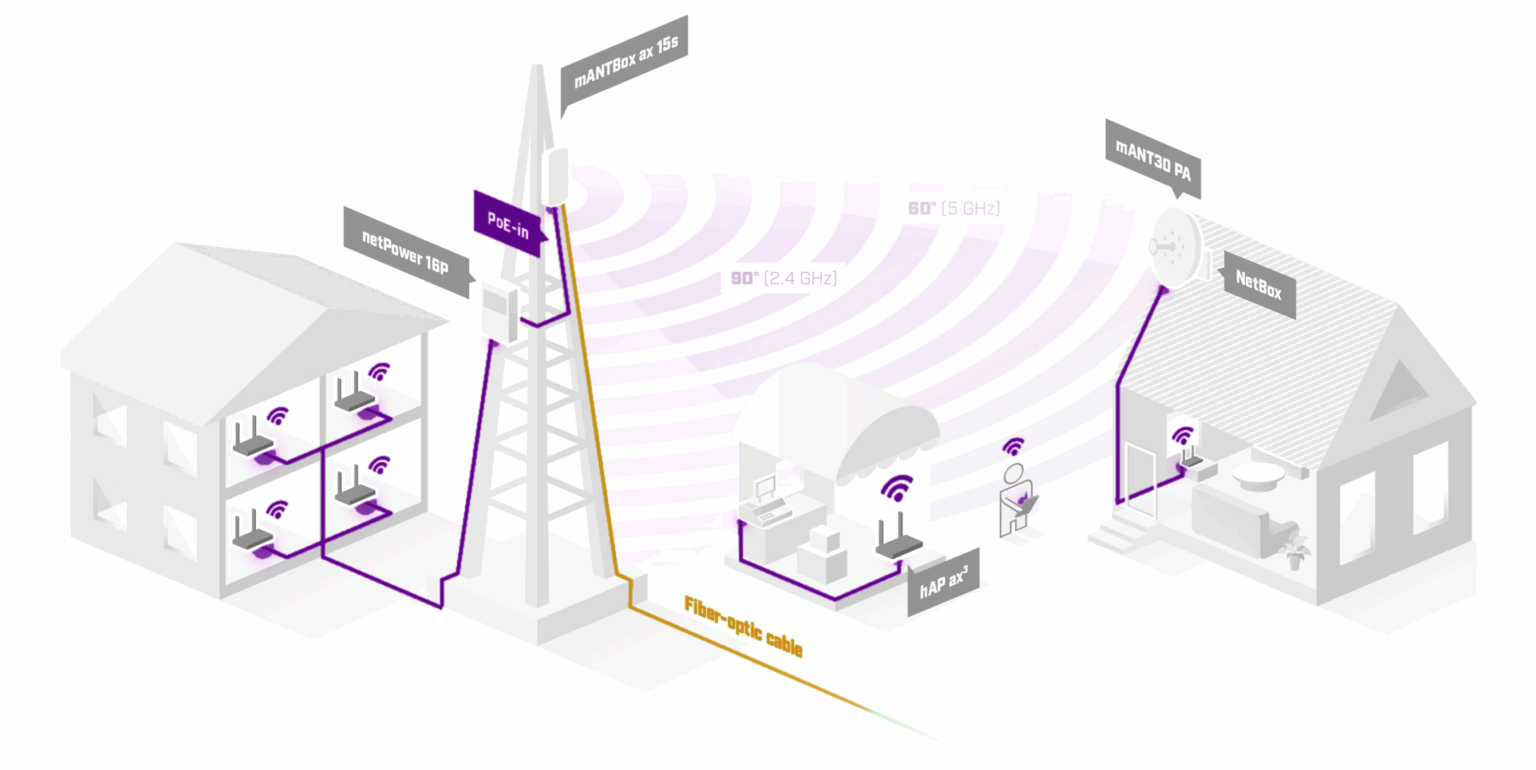
Example of sector coverage and point-to-multipoint deployment.
How far can it reach in practice?
Phones, tablets and laptops
For ordinary mobile devices, plan coverage in zones rather than around a kilometre claim. The base station may transmit a strong signal, but the phone must also send data back. Its antenna and transmit power are much weaker.
In open conditions, useful coverage can extend hundreds of metres. Trees, containers, parked vehicles, walls, terrain and low mounting height can reduce that quickly. A visible SSID is not enough; the connection must remain stable in both directions.
Directional CPEs and point-to-multipoint links
The manufacturer’s “up to 20 km” figure belongs to this scenario. Remote sites use directional CPEs aimed back at the mANTBox, with clear line of sight, correct alignment and enough Fresnel-zone clearance.
That can suit remote buildings, gatehouses, cameras or other fixed endpoints. It should not be interpreted as 20 km Wi-Fi for phones.
Why does the sector antenna matter?
A sector antenna sends most of its useful energy in one direction. This improves coverage where it is needed, but makes installation less forgiving.
A client outside the main coverage pattern may perform worse than a more distant client that is properly aligned. The same applies vertically: if the unit is mounted too high or tilted incorrectly, the strongest part of the signal may pass above or below the service area.
This is why mounting height, tilt and a clear path should be checked before channel width or transmit power is increased.
Which specifications matter most?
| Feature | What it means |
| Wireless | Dual-band Wi-Fi 6, 2x2 on 2.4 and 5 GHz |
| Maximum radio rate | 574 Mbit/s at 2.4 GHz; 2400 Mbit/s at 5 GHz |
| Antenna gain | 12 dBi at 2.4 GHz; 15 dBi at 5 GHz |
| Wired uplink | 1 × Gigabit Ethernet and SFP with 2.5G module support |
| Power | Passive PoE input or DC jack |
| Outdoor design | IP55, passive cooling, pole/wall mounting |
| Software | RouterOS v7 with VLANs, routing, firewall and monitoring |
2.4 GHz or 5 GHz?
Use 5 GHz when capacity and cleaner spectrum are the priority. It is the natural choice for fixed links and faster outdoor access. Use 2.4 GHz for broader compatibility and better reach around partial obstructions, but expect more interference and lower capacity.
When is the 2.5G SFP uplink useful?
Fiber is useful when the access point is far from the network room, when electrical isolation is desirable, or when traffic from both radios could exceed a 1 GbE uplink. The SFP port removes a possible wired bottleneck, but real wireless speed still depends on the client, channel conditions and protocol overhead.
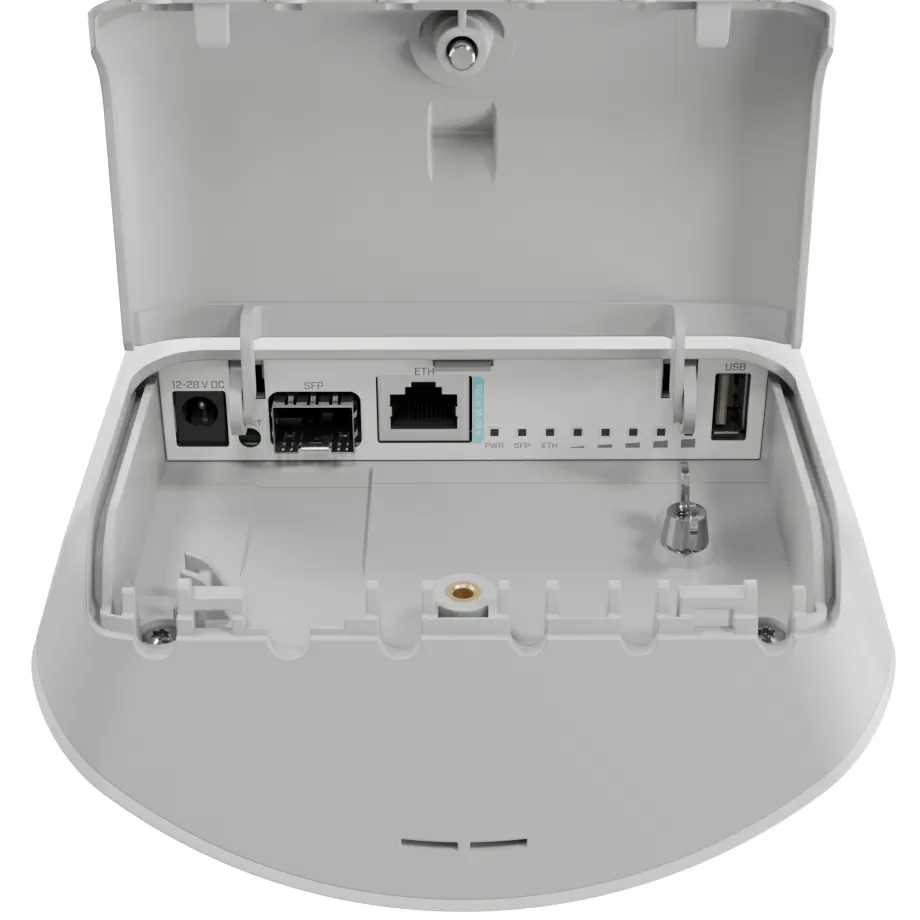
Ethernet, SFP and power interfaces.
Where does mANTBox ax 15s fit best?
| Scenario | Why it fits |
| Campsites and RV parks | Cover rows of pitches, cabins or shared outdoor areas from one elevated position. |
| Warehouse and industrial yards | Connect handheld devices, vehicles and fixed equipment across an open working area. |
| Campuses, parking areas and venues | Serve users located mainly in one direction from a pole or building. |
| Remote buildings and cameras | Build point-to-multipoint links without running cable to every endpoint. |
What to consider before choosing mANTBox ax 15s
| Situation | Good choice — sector antennas concentrate coverage where it is needed. |
| Outdoor area mainly in one direction | Good choice — suitable for point-to-multipoint deployments. |
| Several fixed CPEs connected to one base station | Good choice — the SFP port provides additional uplink flexibility. |
| Remote installation with a fiber uplink | Consider an omnidirectional outdoor access point instead. |
| Coverage needed equally in all directions | 1 × Gigabit Ethernet and SFP with 2.5G module support |
| Buildings, dense trees or terrain block the path | Additional access points or a different placement may be required. |
What should be checked before installation?
- Map the real service area and confirm that it fits inside one sector.
- Separate mobile-device coverage from fixed CPE links.
- Check line of sight and Fresnel-zone clearance for long links.
- Set the correct country and outdoor regulatory profile in RouterOS.
- Choose mounting height and tilt before increasing transmit power.
- Confirm passive-PoE voltage and cable length.
- Decide whether 1 GbE is enough or a compatible 2.5G SFP module is required.
- Test RSSI, SNR, retries, latency and real throughput at the critical locations.
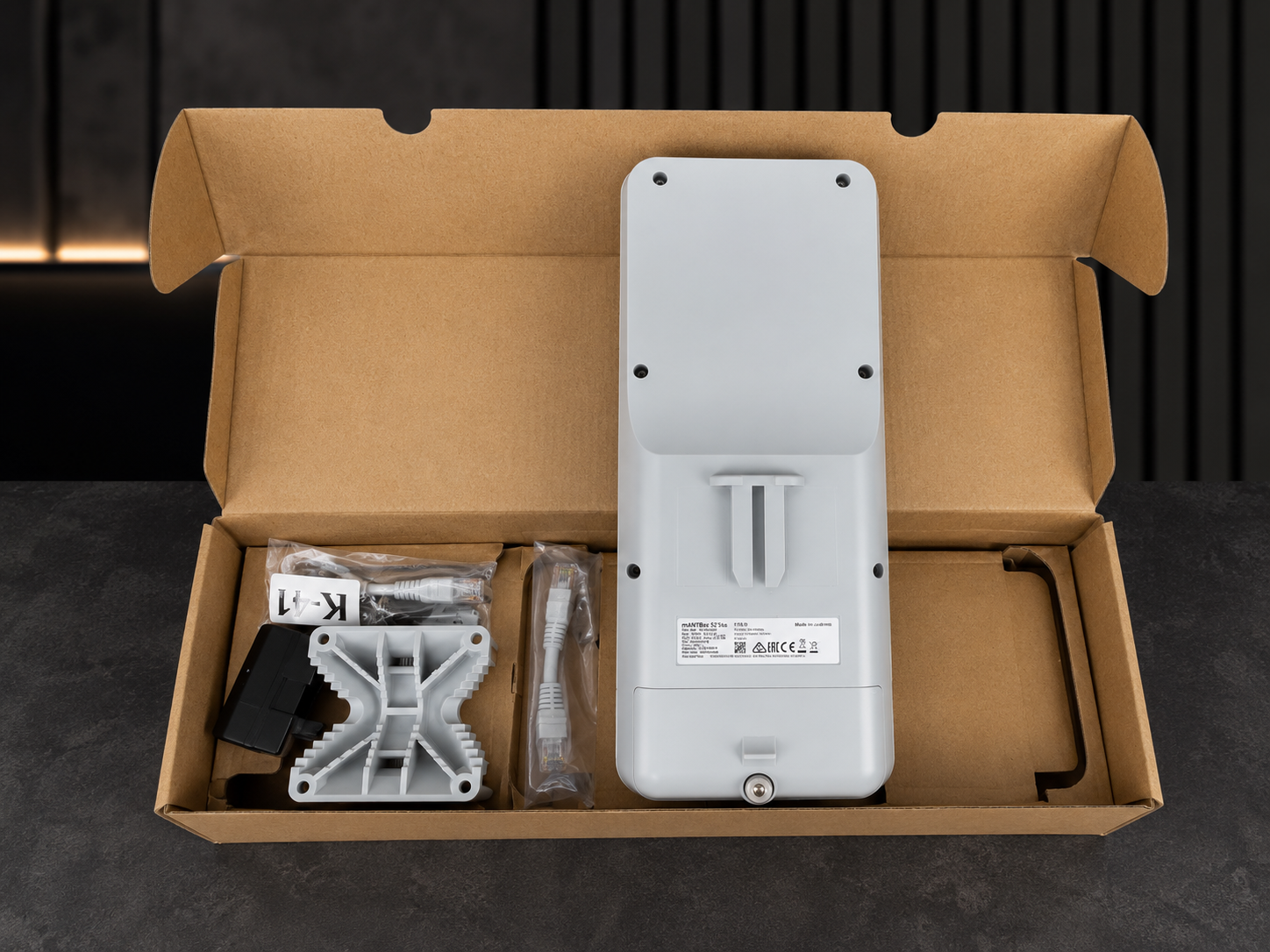
Included mounting hardware and accessories.
Conclusion
MikroTik mANTBox ax 15s is a practical choice when an outdoor network needs controlled directional coverage. It can serve mobile clients across a defined area or connect several remote CPEs from one base station.
Its success depends less on the maximum range claim and more on the site layout. If the service area is inside the sector, the path is clear and the unit is mounted correctly, it can replace a more complicated combination of separate outdoor radios, antennas and enclosures.


